

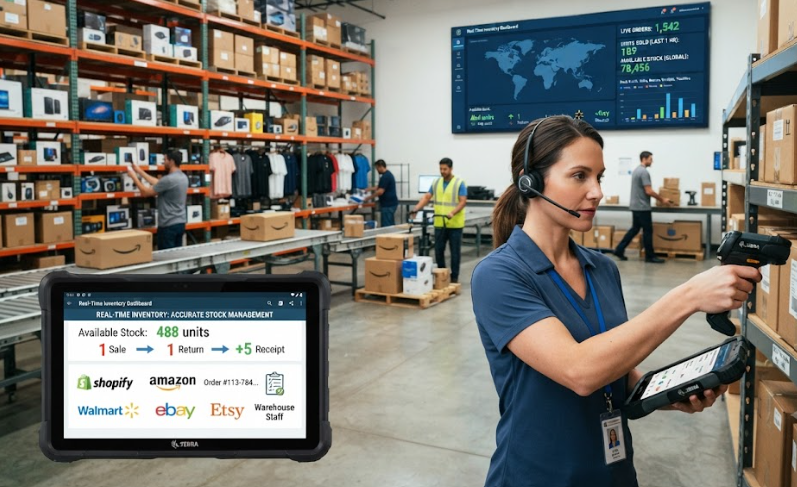








Effective eCommerce inventory management is the difference between a scaling brand and a failing one in 2026. With rising warehouse costs at Walmart (WFS) and Amazon (FBA), sellers can no longer afford to “guess” their stock levels.
When your data is delayed, you face a double-edged sword: you either run out of stock and lose your search ranking, or you overstock and watch your profits disappear into storage fees.
This guide breaks down the eight metrics you must monitor to stay lean and profitable.
If you sell on more than one channel, your inventory risk multiplies fast. That is why multichannel systems and clean workflows matter. Start here if you want the full framework: The Ultimate Multichannel Selling Guide.
Why Metrics Matter More in 2026
Modern inventory management is no longer just about counting stock. In 2026, major marketplaces can tie your selling capacity to inventory health signals and storage controls. For example, Amazon uses the Inventory Performance Index (IPI) to evaluate inventory efficiency, and storage and restock limits can be affected when inventory performance is poor.
Metrics also matter because customers judge brands by fulfillment outcomes, not promises. McKinsey’s research on eCommerce deliveries found that shoppers place strong value on items arriving within the promised delivery window, and on-time delivery can matter more to satisfaction than fast delivery in many cases. You can review the study overview here: McKinsey on what U.S. consumers want from eCommerce deliveries.

That combination creates a clear reality in early 2026. If you do not track inventory turnover, stockout rate, sell-through, and returns, you risk both marketplace restrictions and customer churn driven by unreliable delivery experiences.
The 8 Essential Inventory Metrics
1. Inventory Turnover Rate
This measures how many times you sell through your entire stock in a year.
Inventory Turnover = Cost of Goods Sold (COGS) / Average Inventory Value
- Low Turnover: You have “dead stock” taking up space.
- High Turnover: You are selling fast, but check if you are losing sales to frequent stockouts.
2. Days Sales of Inventory (DSI)
DSI tells you exactly how many days it takes to turn your current stock into cash. In 2026, the goal for most marketplace sellers is a DSI of 30–45 days.
3. Stockout Rate
This is the percentage of time a product is unavailable when a customer wants to buy it. Even a 2% stockout rate can cause a permanent drop in your Walmart or Amazon search visibility.
Stockouts often start with delayed updates and manual processes that cannot keep up as you grow. If you want to reduce that manual work, see Ecommerce Automation Tools You Need in 2026.
4. Gross Margin Return on Investment (GMROI)
GMROI answers the question: “For every dollar I spent on this stock, how many dollars did I get back?”
The Formula: GMROI = Gross Profit / Average Inventory Cost
If your GMROI is below 1.0, you are losing money on every unit you store.
GMROI gets easier to improve when you can see profit drivers by SKU instead of guessing based on revenue alone. This breakdown explains how sellers use analytics to scale decisions: How to Use Profit Analytics to Scale.
5. Order Accuracy Rate
This tracks the “Perfect Order.” If you send the wrong size or color because your inventory sync failed, your return rate will spike. 2026 standards require an accuracy rate of 99.8% or higher.
6. Carrying Cost of Inventory
This is the “Hidden Profit Killer.” It includes warehouse rent, insurance, and labor. Carrying costs typically average 20–30% of your total inventory value per year.
7. Sell-Through Rate
A critical metric for seasonal sellers. It compares the amount of inventory you received from a supplier against what you actually sold.
Sell-Through % = (Units Sold ÷ Units Received) × 100
8. Return Rate (Due to Inventory Error)
If your Inventory Management system shows 10 units of “Red” but you actually have “Blue,” you will face high return rates. Tracking the reason for returns helps identify where your warehouse sync is failing.
Turning Data into Profit with CrazyVendor
Monitoring these numbers manually in a spreadsheet is a “Death Trap” for growing sellers. You need a system that updates in real-time.
- Real-Time Sync: Our Inventory Management tool ensures that when an item sells on Walmart, the stock level is instantly updated on Amazon and Shopify.
- Preventing Errors: By using Warehouse Management, your team uses barcodes to pick and pack, ensuring your Order Accuracy Rate stays near 100%.
- Analytics: For a deep dive into your numbers, use Profit Analytics to see exactly which SKUs are dragging down your GMROI.
Conclusion
Inventory is either an asset or a liability. By tracking these 8 metrics, you move from “reactive” selling to “proactive” growth. In 2026, the winners will be the sellers who treat their data with as much respect as their products.
If you are ready to automate your metrics and stop the manual counting, explore CrazyVendor’s plans or see a demo of our inventory sync here.